
Mason
- SexMale
- ColorFawn
- Age9 weeks
$700Available
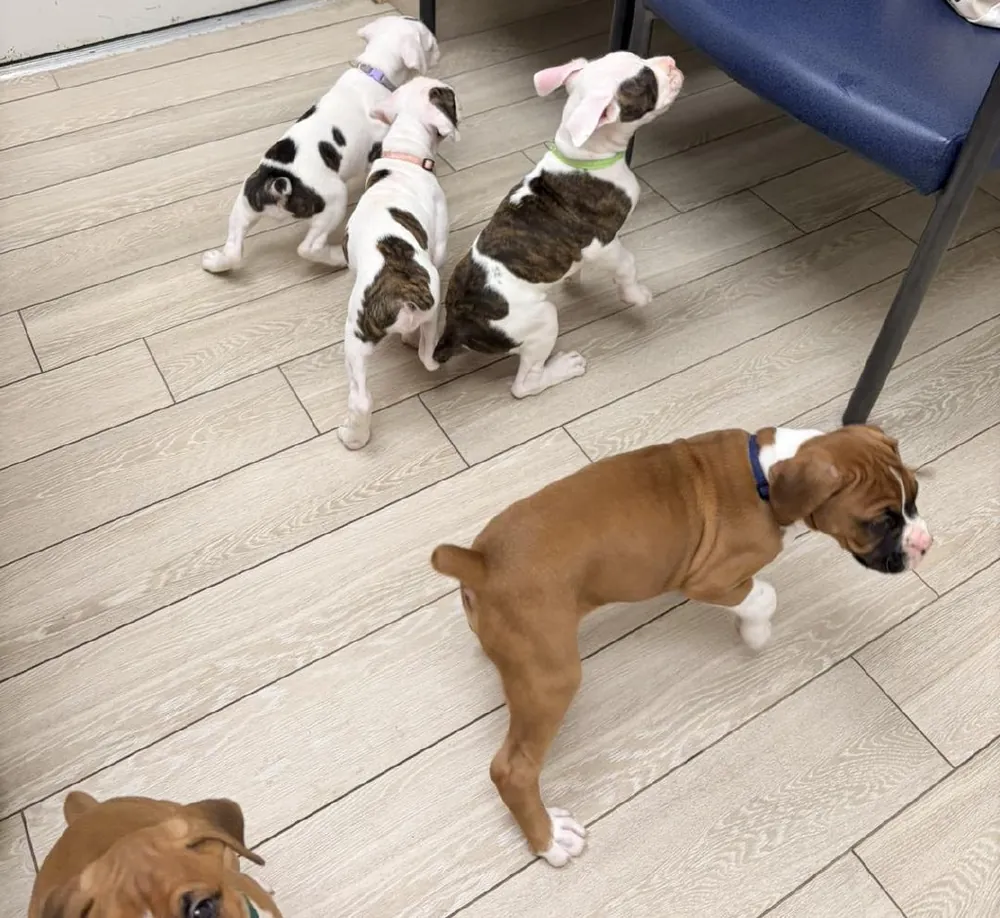
A Boxer with its tail intact surprises a lot of people in the US, because most of the Boxers they have seen had a short stub and upright, pointed ears. Neither look is how the dog was born. Boxers arrive with a full-length tail and soft, folded ears, and docking and cropping are things done to them afterward, by choice. Our puppies go home at 9 weeks with docked tails and cropped ears, the classic look described in the AKC standard.
This guide covers what each procedure involves and when it happens, what the AKC, the FCI and UK law say, and the arguments on both sides, stated as fairly as we can. If you are browsing our available Boxer puppies, it also lists the questions worth asking before you apply for one.
Yes. Nearly every Boxer is born with a full tail. A short Boxer tail is almost always a docked one, removed in the first days of life. An undocked Boxer tail is set high, tapers toward the tip, and is usually carried up when the dog is moving or excited. The UK Kennel Club standard, which now describes both versions, asks for an undocked tail that is "set on high and carried gaily, of moderate thickness."
Natural bobtails are rare in the breed. A bobtail line was developed in the UK by crossing a Boxer with a Pembroke Welsh Corgi and then breeding the offspring back to Boxers for several generations. Outside those lines, if someone tells you a short-tailed puppy was "born that way," it is fair to ask how they know.
So when people search for Boxer puppies with tails, what they are really looking for is a litter that was left undocked. That decision is made within a few days of birth, long before any puppy is ready to leave.
Docking is done very early, usually when puppies are two to five days old, while the tail is still soft and small. The two common methods are cutting the tail with surgical instruments, or banding, where a tight rubber ring cuts off the blood supply until the end of the tail dies and falls away. Newborn docking is usually done without general anesthesia, which is one of the main reasons the practice is debated.
We won't describe how to dock a tail at home, and we would steer any owner away from trying it. A veterinarian can control bleeding, judge the length and treat an infection if one starts. Some US states also set rules on who may perform these procedures, so check your local law before assuming anything is allowed.
Ear cropping is surgery. A veterinarian trims part of each ear flap under general anesthesia, then shapes and stitches the cut edge so the ear can be trained to stand. It is usually done when a puppy is somewhere around two to three months old, while the ear cartilage is still soft enough to shape. Many vets prefer not to crop older puppies, because the ears become harder to train as they firm up.
Boxer crops come in different lengths. A longer "show" crop follows the classic look seen in the AKC ring, and shorter crops are common in pet homes. Longer crops usually take more work to stand.
Our guide to Boxer health problems explains why that check matters.
Recovery has two stages. The first is healing. The cut edges are sore for a while, the puppy usually wears a cone so it cannot scratch, and stitches typically come out after a week or two. Your vet will send pain relief home and show you how to keep the edges clean.
The second stage is posting, and it lasts much longer. Once the edges have healed, the ears are taped or supported so they set upright while the cartilage strengthens. Owners re-tape on a schedule for weeks to months. Some ears stand quickly, some take a long time, and a few never stand fully, even with careful work.
Uncropped Boxer ears are thin and of moderate size, set high on the head. The AKC standard describes them lying flat and close to the cheeks at rest, then "falling forward with a definite crease when alert." That fold gives a natural-eared Boxer its softer, more open expression.
Natural ears do not stand up on their own, and they are not meant to. Care is simple: look inside once a week, wipe dirt from the outer ear, and see your vet about redness, a bad smell or head shaking. Our Boxer shedding and grooming guide covers ear cleaning along with nails and teeth.
In the US, uncropped Boxers are common in family homes, and they can be shown in the AKC ring, because the standard gives a full description of the natural ear.
Registration and showing are separate questions. AKC registration depends on a puppy's registered parents, not on its tail or ears, so a natural Boxer can be registered like any other. Sports such as obedience, rally and agility do not judge tails or ears at all.
Conformation shows are different. The current AKC Boxer standard, approved in 2005, still reads: "The tail is set high, docked, and carried upward. An undocked tail should be severely penalized." For ears, it says they "are customarily cropped," then describes uncropped ears in detail. In practice, natural ears are accepted in the AKC ring, and a natural tail is a serious fault there.
The AKC's own policy statement says that ear cropping, tail docking and dewclaw removal, "as described in certain breed standards, are acceptable practices integral to defining and preserving breed character and/or enhancing good health." It adds that appropriate veterinary care should be provided.
In Europe the picture is the reverse of the AKC's. The FCI standard for the Boxer, used across most of continental Europe, describes "natural ears" and a tail "of normal length and left natural." Many European countries also ban cosmetic docking and cropping outright. If you have seen photos of German Boxers with long tails and folded ears, that is why. Our page on American and German Boxers covers the other differences between the two.
In the UK, ear cropping is illegal. In England and Wales, the Animal Welfare Act 2006 made tail docking an offense from 2007, apart from medical treatment and certified working dogs of certain types, and the Boxer is not one of those types. The same law bars docked dogs from shows where the public pays to get in. The Kennel Club standard now says the tail was "previously customarily docked" and describes both docked and undocked tails.
People who favor the traditional look point to the breed's history and to the AKC standard, which still describes the docked, cropped Boxer as correct. Some also argue that a long tail on a wiggly, enthusiastic breed gets knocked against walls, crates and furniture, and that a split tail tip can be slow to heal.
People who object point out that in a pet dog, both procedures are done for appearance. The American Veterinary Medical Association opposes ear cropping and tail docking when they are done only for cosmetic reasons, and it has encouraged removing them from breed standards. Critics also raise the pain of newborn docking, the anesthesia and long aftercare that cropping needs, and the fact that dogs use their tails and ears to communicate.
Our view is simple. Neither look changes a Boxer's personality, which comes from breeding and upbringing, as our Boxer temperament guide explains. Our puppies go home docked and cropped, so if you want a natural Boxer, it is worth knowing that before you apply.
Because docking happens in the first days of life, the time to ask is before a litter arrives, or as soon as you hear about one. Cropping comes later, so there is a little more time, but it is still worth settling early. Whether you want a natural puppy or are comparing Boxer puppies with ears cropped, these questions keep things clear:
Get the answers in writing so nothing rests on memory. For broader questions, our Boxer questions and answers page is a good next stop, and you can ask us anything through our contact page or start with the puppy application. Every puppy we list has a docked tail and cropped ears; see which are available now.
Puppies are born with their ear canals sealed, and they open at around two weeks old. This has nothing to do with cropping, which happens weeks later.
The surgery is done under general anesthesia, so the puppy does not feel the procedure itself. The cut edges are sore while they heal, which is why vets send pain relief home, and the weeks of posting take patience from puppy and owner alike.
It gets harder as the cartilage firms up, and many vets prefer not to crop past young puppyhood because the ears are less likely to stand. Talk to a vet who regularly crops Boxers before assuming it can be done.
There is no nationwide ban, so docking is legal in most of the country. Some states set rules on who may do it and at what age, so check your state's law and use a veterinarian.
Not much. Keep an eye on the tip, because an excited Boxer can whack its tail against walls or a crate hard enough to split the skin, and see your vet if a wound keeps reopening.
No. Uncropped Boxer ears fold forward and stay that way for life, which is exactly what the AKC standard describes for a natural ear.
 Boxer Health Problems and What to Ask a BreederThe main Boxer health problems, from cancer and ARVC to hips, bloat and allergies, plus the screening tests that exist...Read the guide
 Do Boxers Shed? What Living With a Boxer Coat Is Really LikeDo Boxers shed a lot? How much they shed and when, why they are not hypoallergenic, and simple care for coat, drool,...Read the guide
 Boxer Temperament and PersonalityBoxer temperament explained: whether Boxers are aggressive, how they do with kids, dogs and cats, their energy, guarding,...Read the guide
 American vs German BoxerOne breed, three standards. How the American, German and English Boxer differ in head, build, height, tails, ears, color...Read the guide
 Boxer Puppy Training: What to Teach and WhenBoxer puppy training from day one: socialization, reward-based methods, potty and crate training, biting, jumping, leash...Read the guide
 Boxer Puppy Names for Every Kind of BoxerBoxer puppy names in groups: strong, German, boxing, fawn, brindle and white, girls and boys.Read the guide
See the puppies available now, or ask us anything about the breed.

