
Mason
- SexMale
- ColorFawn
- Age9 weeks
$700Available
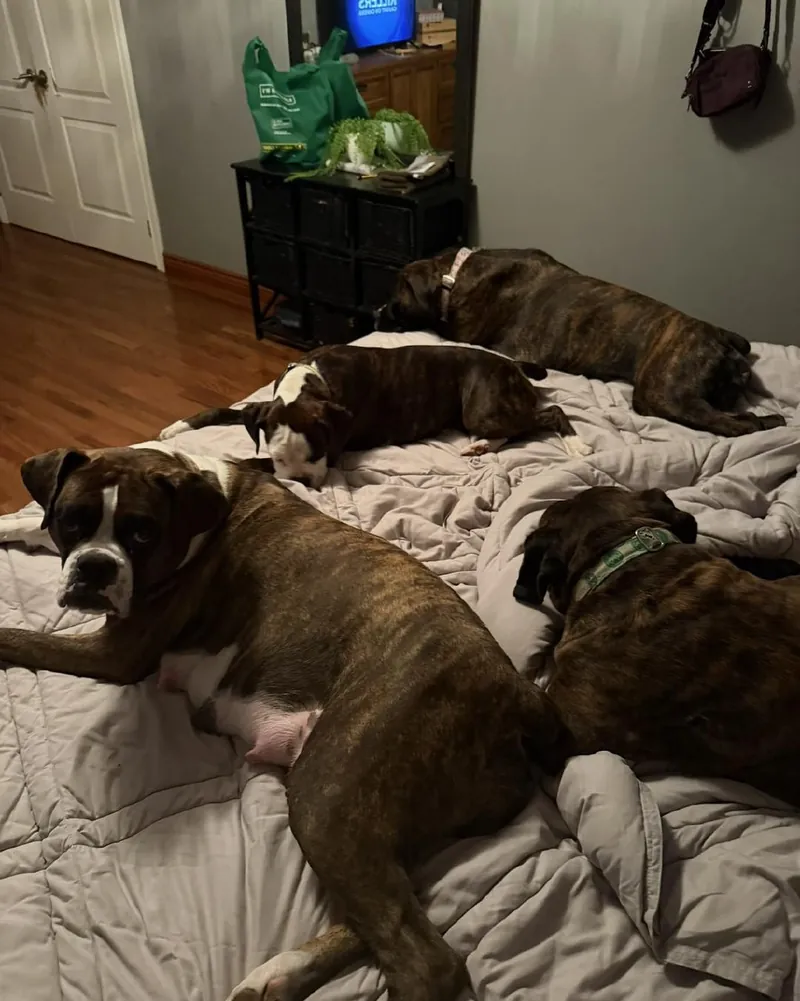
A full grown Boxer is a square, muscular dog that sits between medium and large. So how big do Boxers get? Males stand 23 to 25 inches at the shoulder and usually weigh 65 to 80 pounds, while females stand 21.5 to 23.5 inches and run about 15 pounds lighter.
The heights come from the AKC breed standard and the weights from the American Boxer Club. Further down you will find a Boxer growth chart by age, the point where growth stops, and what a growing Boxer should look like.
The AKC breed standard sets the height range for adults and says nothing about weight. The American Boxer Club fills in the weights, and together they give the standard picture of a full grown Boxer:
| Full grown Boxer | Males | Females |
|---|---|---|
| Height at the shoulder | 23 to 25 inches | 21.5 to 23.5 inches |
| Typical adult weight | 65 to 80 pounds | About 50 to 65 pounds |
Real dogs track these figures closely. In a large Royal Veterinary College study of Boxers seen by UK vets, adult males averaged about 73 pounds and females about 61. Some males grow past 25 inches, which the American Boxer Club acknowledges, and the AKC standard has no size disqualification. What it asks for instead is balance: a well-proportioned dog matters more than one that hits an exact number.
Boxer height is measured at the withers, the highest point of the shoulder blades, with the dog standing square on level ground. Lay something flat across the shoulders and measure straight down to the floor. For most adults the answer falls between 21.5 and 25 inches, which puts the back a little above knee height on an average adult.
The standard also calls for a square outline: the length from the front of the chest to the back of the thigh should equal the height at the shoulder. That is why a Boxer looks compact and athletic rather than long and low. Up on its hind legs, a big male can easily reach an adult's shoulders, which is worth knowing if you have small children or unsteady visitors.
A full grown male Boxer usually weighs 65 to 80 pounds, and a female about 15 pounds less, so roughly 50 to 65. The breed standard notes that males are larger boned than females, so two dogs of the same height can differ by several pounds and both be in good shape.
Bloodlines matter too. If you are comparing different types, our page on the American vs German Boxer explains how the two compare.
One thing that does not exist is a true miniature. The American Boxer Club says plainly that there are no miniature or giant varieties of the breed. Small dogs sold as Boxers are usually mixes or undersized dogs, which our page on the miniature Boxer covers.
There is no official Boxer growth chart from the AKC or the breed club. The ranges below are rough typical figures, worked back from the adult weights above. Dogs vary, plenty of healthy puppies sit above or below these numbers, and a puppy from big parents will usually track high the whole way.
| Age | Males (pounds) | Females (pounds) |
|---|---|---|
| 6 weeks | 6 to 10 | 5 to 9 |
| 8 weeks | 10 to 16 | 9 to 14 |
| 10 weeks | 14 to 20 | 12 to 18 |
| 3 months | 20 to 28 | 18 to 25 |
| 4 months | 28 to 36 | 24 to 32 |
| 5 months | 34 to 44 | 30 to 38 |
| 6 months | 40 to 50 | 35 to 44 |
| 9 months | 52 to 64 | 44 to 55 |
| 12 months | 58 to 72 | 48 to 60 |
| 18 months | 62 to 78 | 50 to 64 |
| 2 years | 65 to 80 | 50 to 65 |
Use the chart as a sanity check, not a target. A steady upward line matters more than where a puppy sits in any given week, and a sudden stall or drop is worth a call to your vet.
A puppy from a tall, heavy sire and a large dam is likely to finish near the top of the range, and one from two compact parents will probably stay smaller. The parents' size is the best guide, so ask any breeder what they know about it.
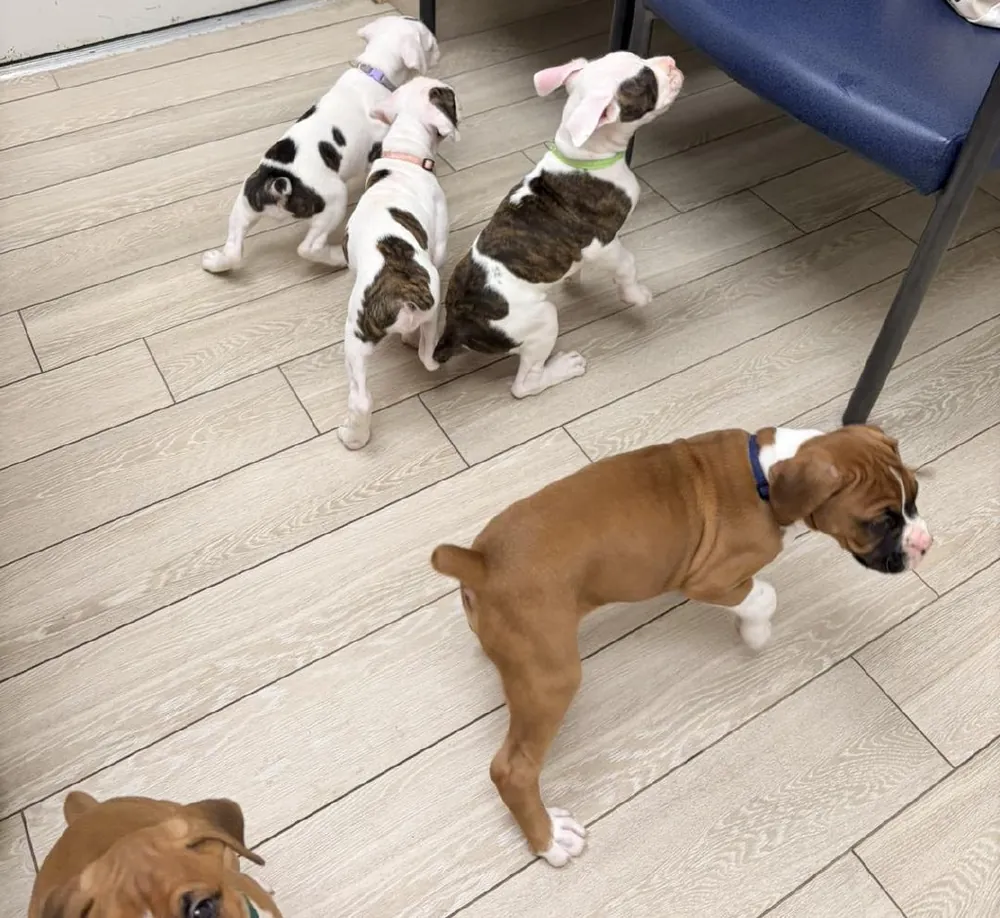
Growth is fastest in the first five or six months. By 6 months most Boxers are somewhere around two thirds of their adult weight, and then the pace slows sharply. Between about 6 and 18 months many go through a gangly stage, all legs and ribs, before the chest drops and the muscle fills in. Big paws are not a reliable sign of a big adult, whatever the old saying claims.
If you are comparing puppies now, see our available Boxer puppies.
Most Boxers reach their full height somewhere between 12 and 18 months. They are not finished at that point. The chest keeps widening and the muscle keeps building until about 2 years old, and some males are still filling out at close to 3. Females tend to finish a little sooner.
Under the skin, the growth plates at the ends of the long bones stay open for much of that first year and a half. That is why many vets advise against forced running, repeated jumping and long hikes for a young Boxer. Free play on grass is fine; jogging beside a bike is not. Our guide to Boxer puppy training has ideas for using all that energy safely.
Lean and athletic at every age. You should feel the ribs easily without pressing and see a waist behind them, and a roly-poly puppy is not a healthy one: fast growth puts extra strain on developing joints.
Extra weight also costs years, as our guide to how long Boxers live explains. For the full body-condition check, with portions and food choices, see our guide to the best dog food for Boxers.
Both answers get used. The AKC standard and the American Boxer Club both call the Boxer medium-sized, but most people who meet one in a small kitchen would say large. Seventy pounds of muscle with a wiggling rear end takes up real space.
In practice, plan for:
Noticeably, but not dramatically. In the breed standard the male range sits about 1.5 inches higher at each end, and males usually carry around 15 more pounds, with heavier bone and broader heads.
Yes. Coat color has no bearing on size, and a white Boxer follows the same growth curve as its fawn and brindle littermates. Our page on white Boxers covers what is different about them.
A 42-inch crate suits most adults, though a small female may fit a 36-inch one. Either way, the dog should be able to stand, turn around and lie flat on its side. Buying the adult size from the start and using a divider while the puppy is small saves buying twice.
Many Boxers go through a lanky adolescent stage when the frame grows faster than the muscle. Seeing the outline of a rib or two is normal at that age, but a visible spine or sharp hip bones deserves a vet check.
Some large males do, especially tall ones, and that can be fine if the dog is lean and fit. Check the ribs and waist before deciding it is all muscle.
 How Long Do Boxers Live?Most Boxers live 10 to 12 years. What the AKC and vet research say about Boxer lifespan, what cuts it short, the senior...Read the guide
 Boxer Temperament and PersonalityBoxer temperament explained: whether Boxers are aggressive, how they do with kids, dogs and cats, their energy, guarding,...Read the guide
 Boxer Dog Food: How to Choose the Right Food for Your BoxerHow to choose Boxer dog food and Boxer puppy food: the AAFCO label, WSAVA questions, calories, meals by age, treats,...Read the guide
 Boxer Puppy Training: What to Teach and WhenBoxer puppy training from day one: socialization, reward-based methods, potty and crate training, biting, jumping, leash...Read the guide
 Available PuppiesBoxer puppies for sale nowSee the puppies
See the puppies available now, or ask us anything about the breed.

